
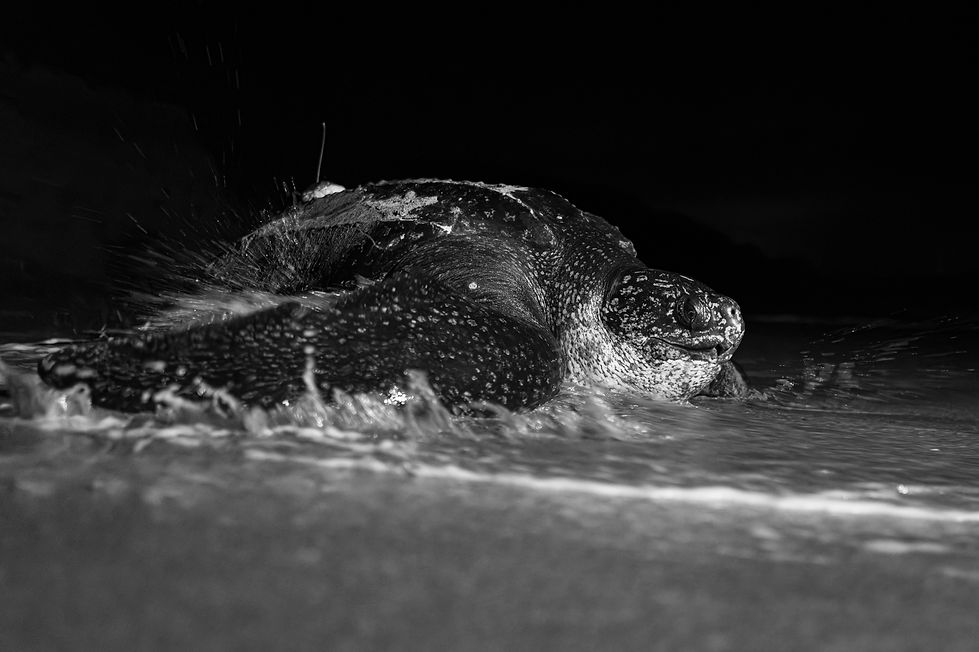
Figure 1. A female leatherback sea turtle returning to the ocean after laying her eggs, tagged with a satellite transmitter on Playa Pajonal, Ecuador. All photos taken with red light only under Ministry of the Environment and Energy permits. Photo credit: Will Lucero.
FOR IMMEDIATE RELEASE
CONTACT:
-
Callie Veelenturf +1 508 315 9464
-
Chris Davey +1 614-886-8658


Scientists deploy first satellite tag on a leatherback sea turtle in Ecuador
This deployment marks a significant milestone for understanding movement patterns for the critically endangered East Pacific leatherback (Dermochelys coriacea) population

Figure 2. Callie Veelenturf (Director of The Leatherback Project) and Kerly Briones (President of Fundación Reina Laúd) reviewing satellite tag placement on a leatherback sea turtle on Playa Pajonal, Ecuador. All photos taken with red light only under Ministry of the Environment and Energy permits. Photo credit: Nikki Riddy.
Additional multimedia to accompany the press release can be found here.
The support of the Zonal Directorate 4 of the Ministry of Environment and Energy of Ecuador was obtained, within the framework of the corresponding research permits:
-
Fundación Reina Laúd Permit #: MAATE-ARSFC-2024-1039
-
The Leatherback Project Permit #: MAATE-ARSFC-2025-0615
SAN CLEMENTE, MANABÍ, ECUADOR (21 March 2026) – A team of scientists has successfully satellite tagged the first Eastern Pacific leatherback sea turtle in Ecuador, unlocking critical new data for a population that has declined by more than 98% of historic levels. The information the satellite tags will provide for the species will be invaluable to the wider leatherback conservation community, giving scientists a more detailed understanding of movements specific to this critically endangered subpopulation, of which less than 1,000 individuals remain.
The team decided to affectionately name the first satellite tagged turtle Lucero (Morning Star in English) for the significance of the data her tag will provide for her species in the East Pacific. A Lucero is the first star that appears at night and the last one to remain in the morning, the one that guides a navigator's way.
“Naming her Lucero is deeply meaningful to us,” said Kerly Briones Cedeño, Ingeniera, President & Director General, Fundación Reina Laúd. “Just as the morning star guides those who navigate the ocean, this turtle will help guide our understanding of leatherback movements and the future of their conservation in Ecuador and across the East Pacific. For years, this species was absent from our beaches, and its return already represents hope. Now, through this satellite tag, Lucero becomes a symbol of direction, knowledge, and renewed commitment to protecting this extraordinary species.”
The nesting leatherback was tagged at 3:06AM on March 20, 2026 on Pajonal Beach approximately 5.5 miles south of Bahia de Caraquez. It took fourteen people four days monitoring over 11 kilometers of beach throughout difficult terrain by foot, motorcycle and boat to make sure the turtle could be encountered in time to deploy the tag. Two nonprofit organizations came together to accomplish this feat: Fundacion Reina Laud, who patrols the beaches between Bahia de Caraquez and Crucita daily to monitor for nesting activity, and The Leatherback Project, whose work in Ecuador focuses on protecting leatherbacks at sea through bycatch reduction technology research and implementation. Through Fundacion Reina Laud, led by Kerly Briones, the team was permitted on the beach to interact with the nesting female, and through The Leatherback Project, led by Callie Veelenturf, the team was provided the training, experience, and equipment needed to safely deploy the satellite tag.
Lucero will hopefully be the first of several tagged turtles in the region, as part of a larger study led by marine biologist Callie Veelenturf of The Leatherback Project and funded by the National Geographic Society to better understand critically endangered leatherback turtles in the East Pacific.
“The data collected will provide fishers and scientists with valuable information on leatherback movement patterns and critical habitat use areas, helping to better target conservation efforts,” Veelenturf said. “Ecuador is one of two places in the world where the rights of the leatherback sea turtles to exist and persist into the future are enshrined in national legal provisions, yet adequately implementing these protections remains a challenge. This effort to satellite tag the first leatherback of Ecuador represents an important step forward, towards using science to better protect the species and upholding their intrinsic and inherent rights through meaningful conservation action.”
The major threat facing leatherback turtles in the region is fisheries bycatch, or the accidental capture and subsequent potential for drowning in gillnets. Due to the decline of the East Pacific leatherback, it is incredibly difficult yet critically important to find and tag individuals of this population. While satellite tagging efforts have been carried out on nesting females in other East Pacific countries, largely Mexico and Costa Rica, this is the first satellite tagged leatherback turtle in Ecuador, the southernmost extent of the East Pacific leatherback’s nesting range.
Before this East Pacific leatherback satellite tagging milestone, Fundación Reina Laúd had been working for nine years in environmental conservation, with special emphasis on the protection and conservation of all species of sea turtles that come to nest on the coasts of Manabi province, particularly on the coastal profile between Crucita and Bahia de Caraquez. Their work focuses mainly on monitoring and protecting nests, releasing hatchlings, scientific research, and environmental education with local communities. The team was well equipped with the experience and knowledge needed to identify the right location and date to attempt the satellite tagging endeavor. In 2021 the foundation reported the first successful leatherback hatching event in Ecuador, and this year has already documented fourteen leatherback nesting events, including five from Lucero, even though they had not yet encountered Lucero while she was nesting. When the team saw Lucero the night of the tagging event, they recognized her immediately from her distinct pink spot on the top of her head, “This is Carioca!” said Johnny Moreira, a conservationist from Fundación Reina Laúd. “Carioca was first identification tagged by Reina Laúd on March 9, 2022 about 11 kilometers south of here!” The team decided to forever call her Carioca Lucero, as she now not only represents the first satellite tagged leatherback of Ecuador, but also the first re-encounter of an identified leatherback in the country.
The Leatherback Project has also been working for seven years in the conservation of sea turtles, previously establishing a long-term leatherback tagging and monitoring program on Panama and Colombia’s Atlantic coast through Proyecto Yaug Galu, working closely with the Guna community in Armila, and local communities in Acandi and Necocli Colombia in collaboration with Fundacion Tortugas del Mar and Cocomasur at one of the largest remaining nesting aggregations in the region. In this initiative, the team fitted 24 satellite transmitters on nesting females to map their inter-nesting and broader migratory movements, producing data that are now being used to identify critical habitats, migratory corridors, and potential threats to the species, and to inform local and regional conservation strategies. These satellite tracks have not only expanded scientific understanding of where leatherbacks travel after nesting, but also strengthened advocacy around coastal development and policy decisions by providing evidence-based insights into how these turtles use both nearshore and offshore waters. In Ecuador, the team’s efforts are focused on decreasing fisheries bycatch through understanding fisher perspectives on conservation, data collection and fleet implementation of bycatch reduction technology as well as working with government and community stakeholders to develop and scale comprehensive solutions for Ecuador’s artisanal gillnet fishing fleet. The team hopes to continue their field efforts in Ecuador to satellite tag more individuals, in collaboration with local fishermen and conservation organizations.
Complete field team: Kerly Briones Cedeño, Jhonny Moreira, Juan Fernando Pesántez-Muñoz, Luigi Rivero, Ricardo Zambrano, Callie Veelenturf, Amanda Rocafuerte, Luis Paladines, Nikki Riddy, Will Lucero, Miguel Cevallos, Yower Morán, Pia Beltrán y Rafaela Dueñas.
Funding for the satellite tagging equipment was provided by the National Geographic Society, and funding for the fieldwork was supplied by WildAid and the Alfred Kobacker and Elizabeth Trimbach Fund. Likewise, the support and accompaniment of the Zonal Directorate 4 of the Ministry of Environment and Energy of Ecuador was obtained, within the framework of the corresponding research permits.

Figure 3. Celebratory team photo after the first deployment of a satellite tag in Ecuador. There were 6 biologists and conservationists and 2 photographers present from Fundación Reina Laúd and The Leatherback Project. From left to right: Yower Morán, Kerly Briones, Johnny Moreira, Amanda Rocafuerte (Ecuador), Callie Veelenturf (USA), and Luis Paladines (Ecuador). Documenting the moment are Nikki Riddy (Canada) and Will Lucero (Ecuador). Photo credit: Will Lucero.
Kerly Briones Cedeño, Ingeniera
President & Director General, Fundación Reina Laúd
“For us, carrying out a satellite tagging of a leatherback turtle for the first time is a deeply meaningful moment. For years this species was absent from our beaches, and its return already represents great hope. The leatherback turtle is so important to us that even our organization adopted the name Fundacion Reina Laud in its honor. Before this step, we had already tagged two leatherback turtles with metal tags: the first in March 2022 in Punta Bikini, and the second in Crucita in January 2026. Now, being able to accompany the journey of one of these turtles across the ocean through satellite technology marks a new chapter in our commitment to its conservation.”
Juan Fernando Pesántez-Muñoz, M.Sc, Marine Biology
Co-founder and Scientist, Fundación Reina Laúd
Co-founder and Representative, Academia del Océano
“For us, researching the leatherback sea turtle in Ecuador holds profound significance. For years, our foundation has maintained a steadfast and resilient effort to understand and protect this species. We have witnessed the entire process, from observing adult females arrive to nest, to documenting the first recorded leatherback hatching in the country. Today, being able to continue our monitoring efforts and reach a milestone such as tagging represents yet another step forward in better understanding how the leatherback turtle utilizes our coastlines and waters. In a country that is more ocean than land, protecting Dermochelys coriacea is also a way of understanding and caring for our ocean.”
Johnny Moreira
“Being part of the Reina Laúd Foundation has changed my life. I am a fisherman, but now I also feel that my mission is to protect the leatherback turtle. Every outing, every night of monitoring, has taught me just how important they are. I never thought I would experience something like this, and the truth is, this has become a deep passion for me. Having been part of placing the first satellite tag in Ecuador is something that fills me with pride. I feel very happy—and even more eager to continue caring for them.”
Callie Veelenturf, MSc, Marine Biology
National Geographic Explorer
Founder & Director, The Leatherback Project
“The team is incredibly excited for what this first satellite tag deployment means for East Pacific leatherbacks. The data collected will provide fishers and scientists with valuable information on leatherback movement patterns and critical habitat use areas, helping to better target conservation efforts. Ecuador is the only place in the world where the rights of the leatherback sea turtles to exist and persist into the future are enshrined in the constitution, yet adequately implementing these protections remains a challenge. This effort to satellite tag the first leatherback of Ecuador represents an important step forward, towards using science to better protect the species and upholding their intrinsic and inherent rights through meaningful conservation action.”
Amanda Rocafuerte, Bióloga
Ecuador Director, The Leatherback Project
“Today, Ecuador is not only witnessing the return of the leatherback to our coasts; we are witnessing a possible call from nature to its origin. After years of sporadic nesting, this specimen has returned to write a new chapter in the history of conservation. For the first time, in collaboration with the NGO Reina Laud, we have satellite-tagged this ocean giant, turning its return into a milestone that will allow us to have scientific data and a nesting route that perhaps began on this very beach, and we hope it is not the last.”
Luis Paladines
National Geographic Explorer
Student, Pontificia Universidad Católica del Ecuador Sede Manabí
Field Coordinator, The Leatherback Project
"Our connection and collaboration with artisanal fishermen has shown us that the main threat to the leatherback turtle is undoubtedly fisheries bycatch, which is why Ecuador has been considered the country that has contributed most to its risk of extirpation. However, we are also committed as scientists and fishermen to being the country that achieves the most in actions for its conservation and population recovery.”
Fundación Reina Laúd
Fundación Reina Laúd is a non-governmental, non-profit Ecuadorian organization, legally established since 2019 (previously called Contamos Contigo Ecuador Foundation), whose work is focused on environmental conservation, with special emphasis on the protection and conservation of all species of sea turtles that come to nest on the coasts of Manabi province, particularly on the coastal profile between Crucita and Bahia de Caraquez. The organization’s work focuses mainly on monitoring and protecting nests, releasing hatchlings, scientific research, and environmental education with local communities. Through conservation programs, volunteering, and collaboration with other organizations, they seek to strengthen the protection of endangered species, especially the leatherback turtles, one of the most emblematic and vulnerable marine species on the planet. They work to raise awareness, promote community participation, and ensure that future generations can continue sharing the ocean with these incredible species.
The Leatherback Project
The Leatherback Project is a 501(c)3 nonprofit organization dedicated to protecting the leatherback sea turtle and other threatened and endangered marine species through research, education, and advocacy initiatives primarily aimed at mitigating fisheries bycatch, designating and implementing marine protected areas, and advocating for the intrinsic Rights of Nature. We have been working in Ecuador since 2019 to decrease fisheries bycatch through collecting data on endangered species stranding, fisheries interactions, the effectiveness of bycatch reduction technologies, fishermen’s perspectives on conservation, and working with government and community stakeholders to come up with comprehensive solutions to decrease fisheries bycatch. Our team also works in Panama to identify and study new-to-science sea turtle nesting and foraging grounds throughout the Pearl Islands Archipelago, illuminate key threats to biodiversity, and collaborate with local communities to come up with impactful, long-lasting conservation solutions such as proposing the Saboga National Wildlife Refuge, a new law recognizing the Rights of Nature (Law 287), and the inclusion of the rights of sea turtles in national law. In 2023 The Leatherback Project also started the long-term monitoring program, together with the Guna People of Armila, Panama in one of the largest nesting aggregation of leatherback turtles in the world.